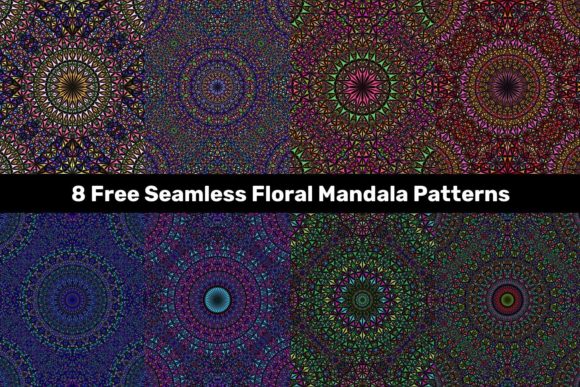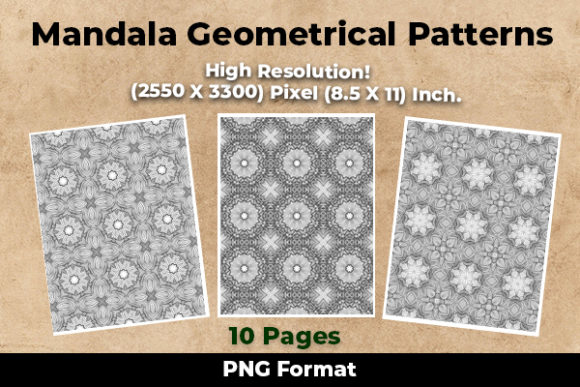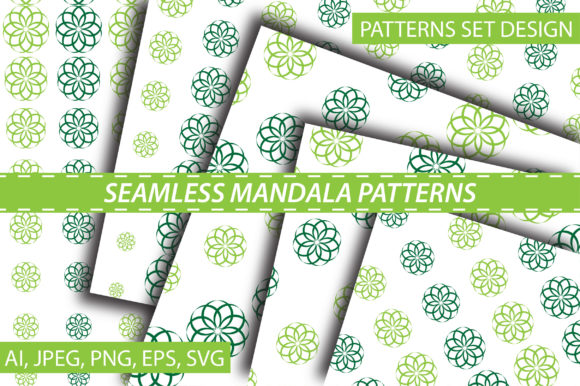
Seamless Mandala Patterns
Seamless Mandala Patterns are repeating, tileable designs built around the balanced, circular symmetry of traditional mandalas—but engineered to join perfectly at the edges. Unlike a single mandala image that sits alone on a page or screen, these patterns flow endlessly in all directions: left, right, up, and down—no visible seams, no awkward gaps, no jarring breaks in rhythm.
Why They Feel So Right—And Why That Matters
Our eyes naturally relax when they encounter harmony, repetition, and balance. Seamless Mandala Patterns tap directly into that instinct. Because each unit interlocks flawlessly with its neighbors, the result feels cohesive and intentional—not like a collage or patchwork. That quiet consistency makes them unusually versatile: calming enough for a meditation app background, intricate enough for boutique packaging, and structured enough for architectural surface design.
What Makes a Pattern *Truly* Seamless?
It’s not just about copying and pasting a circle. True seamlessness requires careful alignment of key visual elements across all four borders—especially radial lines, petal tips, dot clusters, and inner rings. A well-crafted Seamless Mandala Pattern ensures that every line exiting the right edge re-enters cleanly on the left; every curve ending at the top resumes smoothly at the bottom. This precision is what separates professional-grade assets from decorative clipart.
Where People Actually Use Them (Beyond Wallpapers)
Beginners often start with digital wallpapers or printable coloring pages—and that’s a great entry point. But the real value unfolds once you see how widely these patterns adapt:
- Small business branding: A yoga studio might use a soft, lotus-inspired Seamless Mandala Pattern as a subtle texture behind their logo on business cards—or as a repeating motif on reusable tote bags.
- Educational tools: Teachers print them on cardstock for symmetry lessons, then cut them into quarters so students can physically rotate and match segments to understand radial repetition.
- Digital product design: App developers apply lightweight mandala tiles as low-opacity overlays on dashboard backgrounds—adding visual interest without competing with interface elements.
- Textile and surface design: Freelance surface designers license seamless versions to fabric printers, turning one carefully drawn mandala into scarves, wallpaper rolls, or ceramic tile series—all without costly manual tiling.
A Realistic Example: From Sketch to Scalable Asset
Imagine a freelance illustrator sketches a hand-drawn mandala with eight-fold symmetry and delicate linework. To turn it into a Seamless Mandala Pattern, she doesn’t redraw the whole thing. Instead, she isolates the repeat unit—the smallest section that, when tiled, recreates the full effect—then adjusts anchor points along the edges so curves and shapes align pixel-perfectly. The final file works equally well scaled to cover a 4” x 4” phone case or a 10’ x 20’ mural wall.
What to Consider Before You Choose or Create One
Not all mandala-based repeats deliver the same results. Here’s what matters most:
- Resolution and format: For print projects (like fabric or stationery), look for vector files (SVG, EPS) or high-res PNGs (300+ DPI). Web-only uses (blogs, social banners) work fine with optimized PNGs or CSS-ready SVGs.
- Color flexibility: Some Seamless Mandala Patterns come in flat color layers—making it easy to recolor via software like Illustrator or Figma. Others are rasterized with fixed tones, limiting customization.
- Symmetry style: Traditional mandalas often use 4-, 6-, or 8-fold symmetry. But modern variations may blend organic asymmetry with rhythmic repetition—ideal for contemporary brands wanting calm *and* distinction.
- Licensing clarity: If downloading or purchasing, verify whether personal, commercial, or resale rights are included—especially if you plan to sell products featuring the pattern.
How Beginners Can Start Simple (No Design Skills Required)
You don’t need to draw or code to benefit. Many creators use free or low-cost tools to apply Seamless Mandala Patterns instantly:
- In Canva, upload a seamless tile and use “Repeat” under Effects to fill any shape or slide background.
- In Google Slides or PowerPoint, insert the image, right-click → “Format Picture” → choose “Tile” under Fill Options.
- For physical crafts, print a single tile on sticker paper, cut it precisely, and use it as a stencil—repeating by hand for journals, notebooks, or greeting cards.
Even small touches make a difference: a border of tiny mandala repeats along the edge of a newsletter PDF, or a subtle tile as the header background on a wellness blog—it adds cohesion without overwhelming.
When Simplicity Outperforms Complexity
Some of the most effective Seamless Mandala Patterns use minimal linework, open negative space, or monochrome palettes. A beginner trying to replicate dense, highly detailed motifs may end up with a busy, visually heavy result—especially at small sizes. Starting with clean geometry (concentric circles, evenly spaced dots, gentle petal arcs) builds confidence and yields strong outcomes faster.
A Note on Meaning and Mindfulness
While Seamless Mandala Patterns are functional design tools, many users appreciate their quieter resonance too. The act of selecting or arranging them can become a small ritual—a moment of intention before launching a new project, designing a learning module, or refreshing a brand identity. That subtle grounding isn’t accidental. It’s built into the form: center-focused, balanced, self-contained, yet infinitely expandable.
One Last Practical Tip
Before committing to a large-scale application—like printing 500 fabric yardage or engraving on metal—always test your Seamless Mandala Pattern at actual size. Zoom out fully in your design software and scroll slowly in all directions. If you spot even a faint line, mismatched curve, or tonal shift where tiles meet, it’s not truly seamless. Reputable sources will provide previews showing the repeat grid; trust your eyes over marketing language.