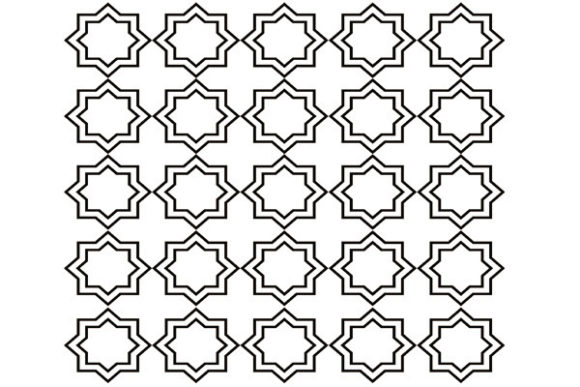
Seamless Islamic Patterns: Design That Flows Without End
Imagine a textile that wraps around a cushion without a visible seam. A wall mural that climbs a staircase and continues onto the ceiling, uninterrupted. A laser-cut panel for a mosque entrance where the geometry repeats flawlessly—no awkward cuts, no mismatched corners. That’s the quiet power of Seamless Islamic Patterns: not just decoration, but intelligent repetition designed to extend infinitely in any direction.
What Makes a Pattern “Seamless” in This Context?
It’s not about invisibility—it’s about intentionality. A seamless Islamic pattern is mathematically constructed so its edges align perfectly when tiled horizontally and vertically. Flip it, rotate it 90°, shift it by one unit—and it still connects. No gaps. No overlaps. No visual stutter. This isn’t accidental symmetry; it’s built on centuries of geometric discipline, refined with modern digital precision.
Unlike a static image or a scanned manuscript page, a true seamless pattern file (commonly delivered as PNG, SVG, or vector-based AI/EPS) behaves like a living tile. Drop it into Adobe Illustrator, Figma, or even Canva, and it will auto-repeat across your canvas—whether you’re designing a 4-inch ceramic tile or a 30-foot façade.
Where These Patterns Actually Show Up in Real Life
You’ve seen them—even if you didn’t know the term. They’re in places where continuity matters more than contrast:
- Architectural cladding and interior walls: Think of contemporary mosques in Dubai or Toronto using laser-etched aluminum panels. The pattern doesn’t stop at the edge of each panel—it flows across joints, reinforcing unity and scale.
- Textile design for modest fashion: Hijab fabrics, abayas, and prayer shawls often use seamless repeats because they drape across the body without abrupt visual breaks. A 12-inch repeat works beautifully on a 72-inch scarf—no seam-line distraction, just rhythm.
- Digital interfaces and branding: Apps serving Muslim communities sometimes embed subtle seamless patterns as background textures—on login screens, donation pages, or Quran study tools. It adds cultural resonance without overwhelming functionality.
- Custom stationery and packaging: Wedding invitations, gift boxes for Eid, or even halal-certified product labels use these patterns to signal identity and care—not through text, but through trusted visual language.
Who Uses Seamless Islamic Patterns—and Why Their Needs Differ
A graphic designer working on a mosque renovation has different priorities than a small-batch ceramicist in Portland—or a teacher preparing classroom posters for an Islamic studies unit. Here’s how their realities shape what “seamless” really means to them:
For Architects & Interior Designers
They need scalability and material fidelity. A pattern that looks crisp at 300 dpi on screen must translate cleanly to CNC-milled wood or powder-coated steel. They’ll often request vector files (SVG or EPS) with clearly defined tile boundaries and color-separated layers—so a gold-leaf accent can be isolated for foil stamping. They also check for modularity: can this same tile be mirrored, rotated, or offset to create variation across large surfaces without breaking continuity?
For Print-on-Demand Sellers & Crafters
Time is tight, and platforms like Spoonflower or Printful require strict tile dimensions (e.g., 3600 × 3600 px at 300 dpi). They look for patterns labeled “true seamless”—not just “inspired by” or “stylized.” One user shared how a misaligned repeat caused her hijab fabric order to show a faint vertical line every 18 inches—costing her three reprints before she switched to verified seamless sources. Lesson? Preview the tile in repeat mode *before* uploading.
For Educators & Community Organizers
Clarity trumps complexity. They often prefer medium-density patterns—clear star-and-polygon structures, minimal layering—so students can trace angles or discuss symmetry in math class. A seamless tile lets them print a single sheet and photocopy it endlessly for hands-on tiling activities. Bonus: many educators pair these with free online tools like GeoGebra to explore rotational symmetry interactively.
Things Worth Checking Before You Download or Commission
Not all “Islamic pattern” files are created equal—and not all seamless ones suit your purpose. Ask yourself:
- Is the repeat truly neutral? Some patterns include subtle gradients or directional shading that break illusion when tiled. Zoom out: does the transition between tiles feel invisible—or does your eye catch a seam?
- What’s the base color model? If you’re printing on fabric, RGB files may shift unexpectedly. CMYK-optimized versions give more predictable results for physical production.
- Are motifs culturally appropriate for your context? A complex 16-point star may resonate deeply in a spiritual space—but feel overwhelming on a children’s book cover. Simpler 8-fold or interlaced strapwork patterns often land more gently.
- Does licensing allow your use case? Free downloads may prohibit commercial resale. Paid libraries often offer extended licenses for product manufacturing—but read the fine print. One candle maker learned the hard way that “personal use only” didn’t cover her branded soy wax containers.
Strengths You’ll Notice Right Away
Once you land on a well-built seamless Islamic pattern, the advantages become practical, fast:
- No more manual tiling: Save hours of alignment work in design software. Drag, drop, and scale—done.
- Adaptable to irregular shapes: Use clipping masks to wrap patterns around arches, domes, or curved signage without distortion.
- Easier collaboration: Share one clean tile file with your printer, developer, or client—no confusion about “how it should repeat.”
- Natural rhythm for restful spaces: Studies in environmental psychology suggest repetitive, non-directional patterns support calm focus—ideal for prayer rooms, meditation studios, or wellness clinics.
A Gentle Reality Check
Seamless Islamic Patterns aren’t magic—they’re tools shaped by constraints. Very dense patterns (think 24-point stars with micro-interlacing) can lose clarity when scaled down below 12 inches or printed on low-resolution fabric. And while digital files offer flexibility, translating them to hand-carved plaster (like traditional girih) requires skilled artisans who understand both geometry and material behavior—software alone won’t bridge that gap.
Also worth noting: “seamless” doesn’t mean “universal.” A pattern optimized for wallpaper may overwhelm a business card. A tile built for embroidery needs stitch-count tolerance—something vector art alone won’t provide. Matching the pattern’s density, motif scale, and visual weight to your medium is part of the craft.
Where to Start—Without Overcomplicating It
If you're new to working with Seamless Islamic Patterns, begin small and tactile. Try printing a single tile on standard paper, cutting it out, and taping four copies together in a grid. Does the star align? Do the lines flow? That simple test reveals more than any spec sheet.
Look for collections tagged with real-world use cases—“for textiles,” “architectural scale,” or “education-friendly”—rather than just “ornamental.” And don’t overlook color: many designers start in monochrome to assess structure first, then add palette thoughtfully. A deep indigo repeat on ivory linen feels grounded. The same pattern in neon green on black vinyl? That’s a deliberate statement—not always the goal.
Ultimately, Seamless Islamic Patterns invite participation—not passive viewing. Whether you’re choosing one for a kitchen backsplash or adapting it for a mobile app background, you’re joining a lineage of makers who believe beauty lives in repetition done with respect, precision, and quiet intention.