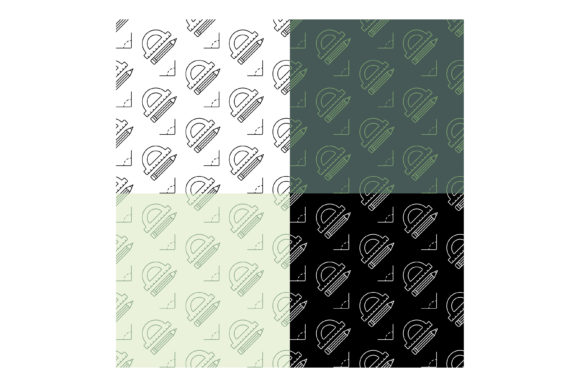
Seamless Pencil Patterns for Designers & Creators
Imagine opening a collection where every pattern flows edge-to-edge without visible seams—drawn with the warmth and texture of real pencil strokes. That’s what Set of Seamless Patterns with Pencil delivers: hand-crafted, repeatable motifs rooted in analog authenticity, digitized for modern use. These aren’t vector abstractions or AI-generated approximations—they’re scanned, cleaned, and carefully tiled to preserve grain, pressure variation, and subtle imperfections that make pencil work feel human.
Why “Seamless” Matters—More Than Just Technical Precision
“Seamless” isn’t just about invisible joins—it’s about usability. A seamless pattern tiles infinitely across any surface: a website background, fabric mockup, notebook cover, or presentation slide—without distracting repeats or misaligned edges. For designers, that means less time fixing offsets and more time refining layout or tone. For educators preparing printable worksheets, it means crisp, consistent borders that won’t break mid-print. For small business owners ordering custom packaging, it means predictable scaling—no surprise gaps when the pattern wraps around a box or label.
What Makes Pencil-Based Patterns Unique?
Pencil textures bring organic contrast and tactility that digital brushes often smooth away. These patterns retain soft graphite gradients, faint eraser marks, cross-hatched shadows, and uneven line weights—all contributing to visual depth and approachability. Unlike high-gloss metallics or hyper-saturated geometrics, pencil-based patterns sit quietly in the background while still adding character. They work especially well for branding that values honesty, craft, or thoughtful minimalism—think indie publishers, tutoring services, sustainable product labels, or handwritten-style newsletters.
Different Needs, Different Priorities
How someone uses Set of Seamless Patterns with Pencil depends heavily on their goals, tools, and context—not just their job title. Here’s how practical concerns shift across roles:
Beginners & Hobbyists: Simplicity First
If you’re just learning design software—or using free tools like Canva or Google Slides—you’ll care most about plug-and-play compatibility. Look for patterns delivered as PNGs with transparent backgrounds and clear instructions for tiling (many come with CSS-ready code snippets or Figma auto-layout guides). A beginner might use one pattern to unify a set of social media posts, or layer it subtly behind a blog header. No need to understand hex codes or offset math—just drag, resize, and go.
Freelancers & Small Business Owners: Speed + Professional Polish
When juggling client revisions and tight deadlines, reliability trumps novelty. You’ll want patterns tested across file formats (PNG, JPG, SVG), color modes (RGB for web, CMYK-ready for print), and common platforms (Figma, Adobe Illustrator, Affinity Designer). One graphic designer used these patterns to build a cohesive brand kit for a local stationery shop—applying the same pencil motif to business cards, Instagram templates, and email headers in under 90 minutes. The consistency saved hours of manual alignment—and clients noticed the “handmade but professional” balance immediately.
Educators & Content Creators: Clarity + Customization
Teachers building lesson slides or printable handouts need patterns that don’t compete with text or diagrams. Light-pencil textures—like faint grid lines or delicate dot clusters—add structure without visual noise. Some educators recolor patterns using simple layer blending modes (multiply or overlay) to match curriculum themes (e.g., cool blues for science units, warm ochres for history timelines). Others export individual pattern tiles to use as clipart elements—turning a single seamless file into arrows, borders, or bullet points.
Print Publishers & Product Designers: Real-World Behavior
For anyone sending files to print—whether greeting cards, fabric swatches, or book endpapers—tile integrity under scale matters deeply. A pattern that looks perfect at 100% zoom may reveal micro-gaps or tonal shifts when enlarged 400%. The best Set of Seamless Patterns with Pencil collections include test prints at multiple resolutions and notes on recommended minimum sizes. One indie zine publisher confirmed that patterns held up cleanly even when scaled to wrap a 12″ × 16″ cover—no visible repetition within a single glance.
What to Evaluate Beyond the Preview
Before downloading or purchasing, ask yourself:
- How many unique base motifs are included? A set of 12 distinct patterns offers more versatility than 50 variations of the same scribble.
- Are color variants built-in—or do you need to adjust them manually? Some sets include grayscale, sepia, and inverted versions; others rely on your software’s recolor tools.
- Is licensing clear for commercial use? Most allow unlimited projects—even client work—but always verify if resale (e.g., selling pre-designed templates) is permitted.
- Do they integrate smoothly with your workflow? Check for native Figma files, Illustrator swatch libraries, or CSS background-repeat examples—not just ZIPs of PNGs.
When This Set Fits—And When It Might Not
This collection shines when you want authenticity without complexity: designing a calm, grounded aesthetic; creating accessible materials (low-contrast pencil textures tend to be easier on eyes than bold patterns); or bridging analog and digital workflows (e.g., scanning student sketches, then overlaying a matching pencil border).
It’s less ideal if you need photorealistic textures (like wood grain or marble), ultra-bright neon palettes, or intricate vector-based illustrations with editable paths. Likewise, if your work demands strict accessibility compliance (e.g., WCAG AA contrast ratios), test each pattern against your foreground text—some light pencil motifs fall below recommended contrast thresholds with pale type.
A Quick Self-Check Before You Use It
- You’re aiming for warmth, tactility, or quiet sophistication—not loud visual impact.
- You value consistency across mediums (web, print, presentation) without rebuilding assets from scratch.
- You prefer working with intentional limitations—like a curated palette or restrained line weight—that focus creativity rather than constrain it.
- You’re comfortable doing light customization (recoloring, scaling, layering) but don’t want to spend hours constructing tiles manually.
Ultimately, Set of Seamless Patterns with Pencil isn’t about replacing skill—it’s about removing friction so your ideas land clearly. Whether you’re sketching a pitch deck, illustrating a children’s worksheet, or wrapping a handmade candle, these patterns offer a quiet, confident foundation. And sometimes, the most effective design choice isn’t what draws attention first—it’s what helps everything else feel intentional, connected, and true.