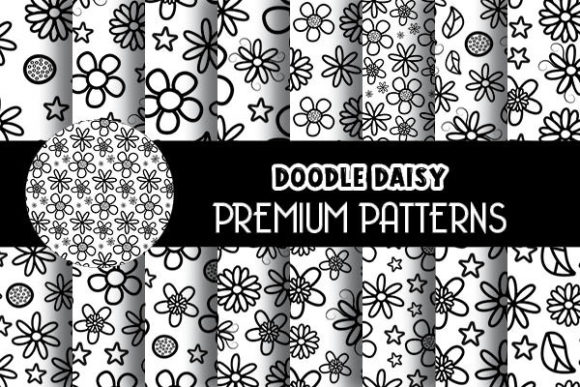
Black and White Doodle Drawing Patterns
Black and white doodle drawing patterns are hand-drawn or digitally rendered repeating motifs—like spirals, waves, geometric grids, botanical silhouettes, or abstract linework—designed in high-contrast monochrome. They’re not just decorative filler; they’re versatile visual tools that rely on rhythm, balance, and negative space to create texture, focus, or calm. Because they omit color, they sidestep chromatic complexity and invite attention to form, flow, and repetition—making them accessible across skill levels and deeply adaptable across media.
Why This Matters—Differently—for Different People
A freelance graphic designer might reach for black and white doodle drawing patterns to add organic warmth to a client’s minimalist brand assets—without introducing color-matching headaches. A middle-school art teacher may use the same patterns to scaffold observational drawing skills: students trace, mirror, or extend a simple zigzag or dot-grid to build confidence in line control and spatial reasoning. Meanwhile, a small-batch ceramicist could laser-etch a custom doodle border onto mugs, turning a single pattern into a signature tactile detail. The core idea stays the same—but its value shifts with context.
For Beginners: Low Pressure, High Return
If you haven’t held a pen with intention since middle school, black and white doodle drawing patterns offer a forgiving entry point. No shading theory. No color wheel confusion. Just pencil, paper, and a willingness to repeat a shape—say, a tiny heart, a crescent, or a four-petal flower—until it flows. Start with a 2-inch square. Fill it using one motif and three rules: keep line weight consistent, leave intentional gaps, and let your hand find its own pace. That square becomes a tile. Tile it. Suddenly, you’ve made something structured, satisfying, and wholly yours.
- What matters most: Simplicity, clear starting points, and visible progress.
- Avoid overcomplicating: Skip complex symmetry at first—even uneven repetition builds muscle memory and visual intuition.
- Try this: Download a free printable “doodle sampler” PDF (many educators share these), then rework one pattern in your own hand—no tracing, just response.
For Educators & Trainers: Structure with Room to Breathe
In classrooms or workshops, black and white doodle drawing patterns serve dual roles: as cognitive warm-ups and as stealthy skill-builders. A five-minute “pattern echo” exercise—where students replicate and slightly alter a teacher-drawn motif—sharpens focus, fine motor control, and pattern recognition. For neurodiverse learners, the predictability of repetition can be regulating; for reluctant drawers, the absence of “right” color choices lowers resistance.
One high-school media arts instructor uses a rotating set of six base patterns (a coil, a ladder, a branching vine, etc.) as weekly sketch prompts. Students choose one, adapt it to reflect a theme—identity, migration, growth—and annotate their choices. The result isn’t just drawing practice—it’s visual literacy in action.
For Design Professionals & Creators
When speed, scalability, and licensing clarity matter, professionals often turn to curated black and white doodle drawing patterns—not as final artwork, but as modular ingredients. A packaging designer might layer a subtle crosshatch pattern behind product copy to add depth without competing for attention. An indie publisher might license a set of inked botanical borders to unify chapter headers across a memoir—consistent tone, zero custom illustration budget.
Key priorities here include vector scalability (so a pattern holds up on a billboard or a business card), clean isolation (no stray pixels or blended layers), and commercial-use rights. A pattern that looks charming as a PNG may fail when scaled for embroidery or foil stamping—so file format and source fidelity aren’t niceties. They’re functional requirements.
For Small Business Owners & Marketers
You don’t need to draw to benefit. Think of black and white doodle drawing patterns as quiet brand amplifiers: the thin-lined swirl framing your Instagram Story highlight icon, the repeated arrow motif guiding eyes down a landing page, the custom pattern printed on recycled kraft thank-you cards. Because they’re monochrome, they integrate seamlessly with any brand palette—no recoloring, no contrast testing.
A local bookstore used a hand-drawn book-stack pattern (single line, no fill) as a watermark across event flyers and tote bags. It wasn’t flashy—but customers began recognizing it as a subtle signal of curation and care. That kind of quiet consistency builds familiarity without shouting.
For Hobbyists & Mindful Practitioners
Here, function blurs with feeling. Many adults return to black and white doodle drawing patterns not to “make art,” but to anchor attention—to breathe, reset, or step out of decision fatigue. The physical act of drawing the same curve, again and again, activates a gentle, rhythmic focus similar to knitting or gardening. There’s no deadline, no critique, no export button. Just mark-making as presence.
One writer uses a 5×5 grid of tiny sunbursts before drafting—200 seconds, no goal beyond completion. Another keeps a “pattern journal” where each page documents one motif explored across three variations: tight, loose, interrupted. It’s not about output. It’s about showing up for yourself in a tactile, unhurried way.
How to Tell If It Fits Your Needs
Ask yourself a few grounded questions—not about trends or tools, but about your real-world constraints and intentions:
- What’s the primary job this pattern needs to do? Decorate? Structure information? Calm your nervous system? Signal brand values? Match that purpose to the pattern’s inherent qualities—e.g., tight geometry for precision, flowing vines for approachability.
- Where will it live? On screen? On fabric? In print? At 2 inches wide or 20 feet tall? That determines whether you need vector files, high-res PNGs, or analog sketchbook practice.
- What’s your tolerance for iteration? If you’re building a brand identity, investing time in custom-drawn patterns pays off long-term. If you’re prototyping a workshop handout tomorrow, a well-chosen free resource is perfectly valid—and wise.
- Does it leave room for you? The best black and white doodle drawing patterns feel like invitations—not prescriptions. You should be able to slow them down, stretch them, break them, or layer them without losing their essence.
There’s no universal “best” pattern. But there is a right one for this project, your hands, and this moment. Start small. Repeat once. Then again. Let the rhythm find you—not the other way around.